23/03/2011

Preliminary Task Storyboard, Reverse Shot, Over the Shoulder & Match on Action

 This is the storyboard for my preliminary task, entitled 'Bag Combat', in which we were required to create a short film that utilised the 180 degree rule, match on action, over shoulder and reverse shots.

Before filming, we had to create a storyboard to draw out the rough outline for each shot. We were required to explain in detail what each panel involved, specify the shot type and illustrate the action.

In the sixth panel I have illustrated a plan to use a reverse shot. A reverse shot is a filming technique in which two separate shots of conversing actors are edited together so that they appear to be talking to one-another off screen (an example of this is Holly and Major Calloway's conversation at the bar in The Third Man). We arranged for our two characters to confront eachother in a reverse shot.

Eyeline matching is used to show the contents of a shot through the eyes of a certain character. The camera takes a shot of the face of a character as they look at something off screen. This shot cuts to one from their point of view, looking at the intended item. An example of this can be seen in Alfred Hitchcock's Rear Window, in which the film's star James Stewart looks out across the block to various other homes, as shown in the film's cinematic trailer. We planned to use this within our preliminary task to highlight what the protagonist is looking at, specifically the culprit character. Using eyeline matching presented some technical difficulties, so we opted for over the shoulder shots instead. Over the shoulder shots, as the name suggests, are shots taken from a third person view over the shoulder of a character, taking a shot of what they are facing toward as well as part of their body.

04/01/2011

Preliminary Task Floor Plan & 180° Rule

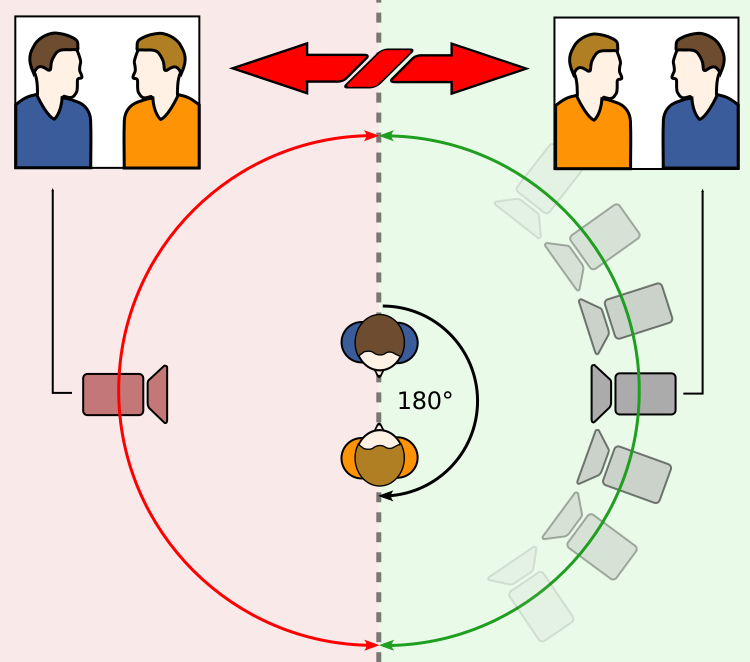
This is the floor plan for the preliminary task. The filming took place in the 6th Form common room and starred Solay & myself. We took extra special care so as not to cross the 180° line on the final shooting, as this caused disorientation on the first two run-throughs. The 180° rule makes it clear that nothing should cross this threshold, so as to promote continuity in the film. Abiding by the rule keeps the audience in a set position, as switching to the opposite side during conversation becomes confusing.
File:180 degree rule.svg
Passing the line would mean going farther than 180 degrees, thus switching the places of each character and reducing the clarity of the film's continuity.

03/01/2011

Preliminary Task Final Product & Evaluation


This is our final product for the G321 Media Preliminary Task, 'Bag Combat'. The short film was created to prove our competence with the use of various continuity techniques, and follows the unnamed protagonist (Solay Elibol) as he returns from the toilet to find an interloper (played by myself) fishing through his belongings.

 In order not to cause confusion or even sickness in the audience, we kept strictly to the 180 degree rule. The film is observed almost entirely from behind the 180 degree line, the only exception being opening shot which follows Solay out of the toilets. As the main aim of the task was to tutor us about the importance of continuity editing, we did our best to incorporate all of the techniques. The shot in which a close-up of Solay shifts to one of me rummaging through the bag uses reverse shots to imply the shot of the antagonist is through Solay's point of view. Because the film is from Solay's perspective, the audience is able to identify him as the main character. The confrontation scene uses over the shoulder shots to piece together the reactions of both characters, promote continuity and position the audience as a bystander to this battle of sorts. The characters also maintain eye contact.
In the group, my responsibilities were drawing up a storyboard, writing a brief script, supervising some shots and, in the latter part of the shoot, acting out the role of the antagonist. I watched tentatively from behind the camera to monitor how the shoot was going up to the time where I was needed in shot, at which point I sat in the required area and was filmed. We seemed to work well as a team, finishing the task within the allocated time and inputting all of our own ideas without any arguments or spitefulness. I tend to get along well with the members of my class, so we worked efficiently enough in a group.
For the shoot we used a small handheld video camera to film the footage. For stability we were given access to a tripod/dolly setup, which allowed us to shoot a smooth segment of Solay's walking through the public toilet door. Adobe Premier Elements was used to cut and edit the footage.
The first minor problem we encountered was stability, which was quickly solved by the dolly. With his permission we used a nearby student's bag for the titular prop. The shoot was done to a unsatisfactory level in the first day because we failed to utilise the 180 degree rule, thus making the end result very disorientating and inconsistent. We went back to shooting the next lesson and filmed the below-par shots again. Luckily for continuity purposes I was wearing the same shirt as the previous shoot. When it came to editing, some shots made a jittering transition, with a flash of a different shot. We cut a few frames from each side of the transition to eliminate this and make for a much smoother short film.
I would rate the shots we filmed as on par with the expectations of the task. They are by no means perfect, but cater to what we were asked to create. The conversation is comprised of mostly close-ups and the approach of Solay is covered at a comfortable distance. The angles of the shots are level with the ground, but sometimes from slightly to the left or right of the action. The movement is smooth enough not to cause irritation, and is steady enough to pick up facial expressions. The sound is at times difficult to follow, especially with background noise in the common room, plus the expression of fright from Solay in the last few seconds of the edit is compiled from two different pieces of audio from the shots. Using the 6th Form common room at the City of Norwich School for shooting made capturing sound more difficult, but had the desired effect of the film taking place in a crowded public area. The narrative is simple but believable in the first segment, but the confrontation is slightly over the top and ends in a quite silly climax.
Upon being watched by a different class from Year 12 for Media Studies, the film was reviewed as fairly good. Continuity editing was adequate and presented the narrative to the audience, and the climatic confrontation stirred some laughter from our peers.

03/11/2010

Conventions of the Thriller in 'Once Upon a Time in America'

Once Upon a Time in America is a powerful American gangster story from the great Sergio Leone, whose roster of films includes the spaghetti westerns featuring Clint Eastwood (the music of which is intertextually referenced in Kill Bill: vol.2). The film in question stars Robert De Niro as Jewish prohibition era bootlegger David ‘Noodles’ Aaronson, once member of a notorious gang along with his childhood friends. In the film we see Noodles’ childhood, his rise to and holding of power in Brooklyn and eventual return in order to face the demons which continue to haunt him.
In the opening scene, Noodles’ apparent girlfriend emerges from the darkness -a darkness seen frequently in the murky light-lacking back alleys of Thrillers- she moves in suspenseful silence toward the bed. She unveils the first defining image of the film, a silhouette of bullet holes, connoting both the violent gang culture of the time and the displacement of Noodles from where he is expected to be. The corrupt and/or incompetent law officials we have learned to expect then arrive, and initiate the indiscriminating violence upon the girl. The willingness to kill and lack of concern for the human life makes us assume the cops share a collective psychopathy. The next scene is ushered in with yet more violence, at levels not normally seen in our naive scope of society, yet in Thrillers this amount of violence is archetypal.   

Conventions of the Thriller in 'Essex Boys'

Essex boys is an archetypal British gang movie released in 2000, based on true events revolving around the death of three drug dealers 5 years prior. The opening scenes begin with a narration from key character Billy (Charlie Creed-Miles) as he prepares to drive psychopathic Essex drug dealer Jason Locke (Sean Bean) to his next victim.

The opening is littered with aspects of the Thriller from the first few seconds. Though the setting may be far closer to home, it still shares conventions with other international Thrillers.

As the titles roll, sinister lines scrape across a black backdrop. These lines appear similar to keying the side of a car, suggesting teenage delinquency. The straight hatching of the strokes also hint imprisonment; brushes with the law are always present in Thrillers. Once the opening credits are done, the narration begins in a hardened Essex twang, associated often with exaggerated brutality in the news - that and Thatcher’s loyal cronies in years passed. The garage doors open into a decrepit hovel of cobwebs and rust, decay of every aspect of life. As Billy wipes the dirt from his van windows, Jason appears through the half-cleaned glass. The filth in which he becomes visible through mirrors his social status and pure lack of morals. The image of the white van is also an ominous and frequent one in the Thriller genre, hinting imminent danger and/or abduction. The abduction comes quickly along with generically raw acts of violence. The seedy activities of violent gangster types culminate at the victim’s dumping on the Essex marshes; the landscape is bleak, dead and featureless, a staple location of Thrillers. Jason’s hapless victim is hurled from the van, still blinded by bombardment by chemicals in the first of many gripping activities; the abandonment and sheer hopelessness of Jason and the roped in Billy’s victim can be found in other Thrillers, following a bleak and unavoidable incident. The character of Billy plays the core role of a fairly innocent young man drawn into the seedy gang culture, who suffers a huge emotional strain for his mistake.

01/11/2010

Conventions of the Thriller in The Third Man

 Often regarded as one of the best films ever made, the 1949 classic The Third Man is a perfect example of early film noir. Joseph Cotton stars as Holly Martins, a failing pulp writer called to war-torn Vienna with a job offer by his friend Harry Lime (played by Orson Welles). After Holly arrives, it comes to light that Harry has apparently been killed in a car crash. As he interrogates the witnesses, holes in the story of how (and if) Harry was ran down begin to surface, and Holly starts to suspect that all is not as it seems. With the reluctant help of Harry’s lover, Anna (Alida Valli), Holly delves into the darkest corners of Vienna in a quest to find the truth. Welles’ performance as Harry Lime, much like his various other cinematic appearances, is extremely mem
orable and well-orchestrated. The film won the Grand Prize of the 1949 Cannes Film Festival, the 1950 BAFTA Film award for best British film and the 1951 Oscar for best cinematography in the Black & White category.
The Third Man is a prime example of film noir, and contains various shots displaying conventional characteristics of thrillers, this including the mystery-driven plot. As the film opens to the Third Man Theme on zither, as the initial voiceover from Major Calloway (Trevor Howard) describes the divided city, the seedy goings on about Vienna become clear. A flourishing post-war black market is hinted visually by the iconic image of the selection of watches; illegal and underground activity is at the centre of countless plots in thrillers. The expected plain and unforgiving view of death and violence is also glimpsed from the get-go; a body drifts in the tide beside the river Wien, signifying the dilapidated state of the city.
Apart from content, the shots in the film also subtly connote stereotypical assets of thrillers. The use of angles in Martins and Holloway’s conversation are very effective. The canted angle and over-shoulder pieces clearly show a conversation is taking place, confusion mounting in Holly’s mind. Holly is seen at a low angle to the man on the staircase when he arrives at Harry’s apartment, as he has no grasp of his surroundings or his peers’ languages; he is a stranger in a strange land. Shadows are utilised throughout the film; Harry is presented as if he is the Yang to Holly’s Ying. Shadows and silhouettes appear to follow Holly, constantly watching his investigation. Black comedy is also included in the ever-so-slightly menacing little boy as he chases Anna and Holly through the streets. The most famous sequence is that of the
sewer scene. The city appears to be a maze, Harry darting in and out of crevices like a cornered rodent. The rule of thirds is applied to focus our attention on Harry’s futile attempts to escape, and Chiaroscuro lighting bathes the waterways.