- First shot - Jason looks into the bathroom mirror. Fade out.
- Cut to Caesar and Helen walking up street, then feet up driveway, then walking at driveway.
- Door opens, Helen walks in.
- Caesar stands at door, Jason slams it shut on Caesar.
- Cut to Turning of tap, Jasonw ashes hands. Repeat from door opening 5 times.
- Final hand washing shot (after gradually revealing blood on Jason's hands) fades out.
- Cut from extreme close-up of Jason to Caesar walking in woods.
- Walking continues. Shot of Caesar's feet cuts between washing of army knife and cutting of pictures. Jason walks behind.
- Cut to Caesar walking up to photo in woodland. Picks up, then makes transition to 3 fast-moving shots of photos.
- 360 degree spinning shot of woods.
- Cut to burning candle. Candles begins to blow out, cuts to Caesar falling, then abck to extinguished candle. Fin.
25/03/2011
Opening to a Thriller - Shot List
Shot list for 'Blind Faith' by Jack Sims

Opening to a Thriller - Storyboard

This is the storyboard to my opening to a thriller, entitled 'Blind Faith'

It charts the camera's intended shots throughout the film and explains briefly how each scene makes transitions and includes sound. (Shot 5 shot type is close-up x3, shot 6 shot type is zoom x3, 360 rotation and another close-up x3. By Jack Sims)
24/03/2011
Original, rough ideas for Thriller
Location: derelict, deserted country road, far from civilisation, situated in a forest.
Characters: Friends of protagonist, delinquent and quick to betray
Teenage protagonist, follows the stereotype of delinquency
Following figure, appears 'normal'
Innocent looking character, appears vulnerable or disabled
Driver of suspicious white van, up to no good
Story:
Characters: Friends of protagonist, delinquent and quick to betray
Teenage protagonist, follows the stereotype of delinquency
Following figure, appears 'normal'
Innocent looking character, appears vulnerable or disabled
Driver of suspicious white van, up to no good
Story:
- Boy is dumped on the side of a deserted and overgrown country road by his friends, who then drive away, leaving him to make his own way home.
- Boy begins walking in the night, then begins to fear for his safety. Unseen eyes are watching him, similar in shot to Halloween.
- Boy becomes increasingly paranoid, hears footsteps, and looks behind on the path to see an inconspicuous young woman, presumably on her own way home. Infront comes a man feeling his way about the pavement with a cane, faking frailty or inability to see.
- Boy is reassured, but then enter the white van. Man with cane reveals himself as nimble/able to see as he comes from behind and throttles the boy with his cane. He and the inconspicuous woman haul the boy into the van and drive away.
Thriller Storyboard 1.0
Original storyboard for Thriller opening/concept, "Drop-off Point", Jack Sims


23/03/2011
Preliminary Task Storyboard, Reverse Shot, Over the Shoulder & Match on Action

This is the storyboard for my preliminary task, entitled 'Bag Combat', in which we were required to create a short film that utilised the 180 degree rule, match on action, over shoulder and reverse shots.

Before filming, we had to create a storyboard to draw out the rough outline for each shot. We were required to explain in detail what each panel involved, specify the shot type and illustrate the action.

In the sixth panel I have illustrated a plan to use a reverse shot. A reverse shot is a filming technique in which two separate shots of conversing actors are edited together so that they appear to be talking to one-another off screen (an example of this is Holly and Major Calloway's conversation at the bar in The Third Man). We arranged for our two characters to confront eachother in a reverse shot.


Eyeline matching is used to show the contents of a shot through the eyes of a certain character. The camera takes a shot of the face of a character as they look at something off screen. This shot cuts to one from their point of view, looking at the intended item. An example of this can be seen in Alfred Hitchcock's Rear Window, in which the film's star James Stewart looks out across the block to various other homes, as shown in the film's cinematic trailer. We planned to use this within our preliminary task to highlight what the protagonist is looking at, specifically the culprit character. Using eyeline matching presented some technical difficulties, so we opted for over the shoulder shots instead. Over the shoulder shots, as the name suggests, are shots taken from a third person view over the shoulder of a character, taking a shot of what they are facing toward as well as part of their body.
04/01/2011
Preliminary Task Floor Plan & 180° Rule

This is the floor plan for the preliminary task. The filming took place in the 6th Form common room and starred Solay & myself. We took extra special care so as not to cross the 180° line on the final shooting, as this caused disorientation on the first two run-throughs. The 180° rule makes it clear that nothing should cross this threshold, so as to promote continuity in the film. Abiding by the rule keeps the audience in a set position, as switching to the opposite side during conversation becomes confusing.
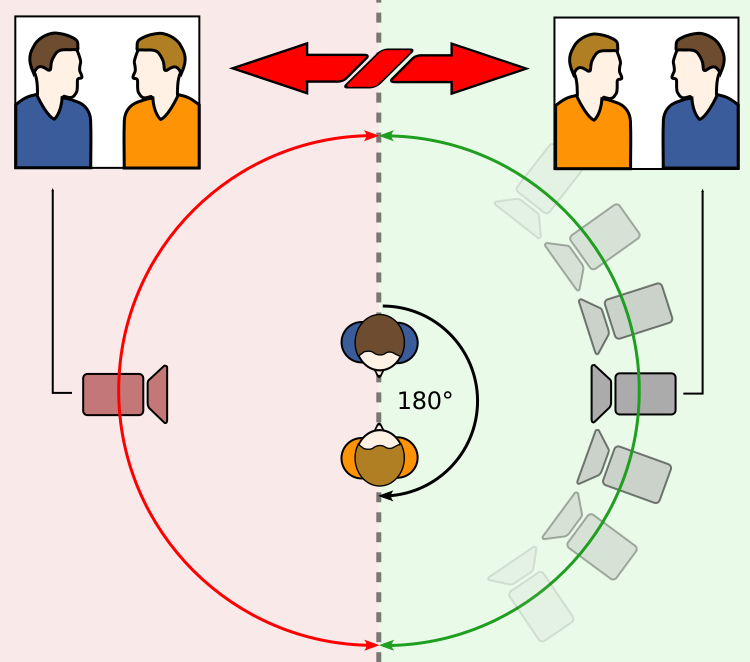
Passing the line would mean going farther than 180 degrees, thus switching the places of each character and reducing the clarity of the film's continuity.
Subscribe to:
Posts (Atom)